
Money With a Soul (and What Happens When It Breaks)
Issue 02 · Friday | THE SHORT CONNECTION
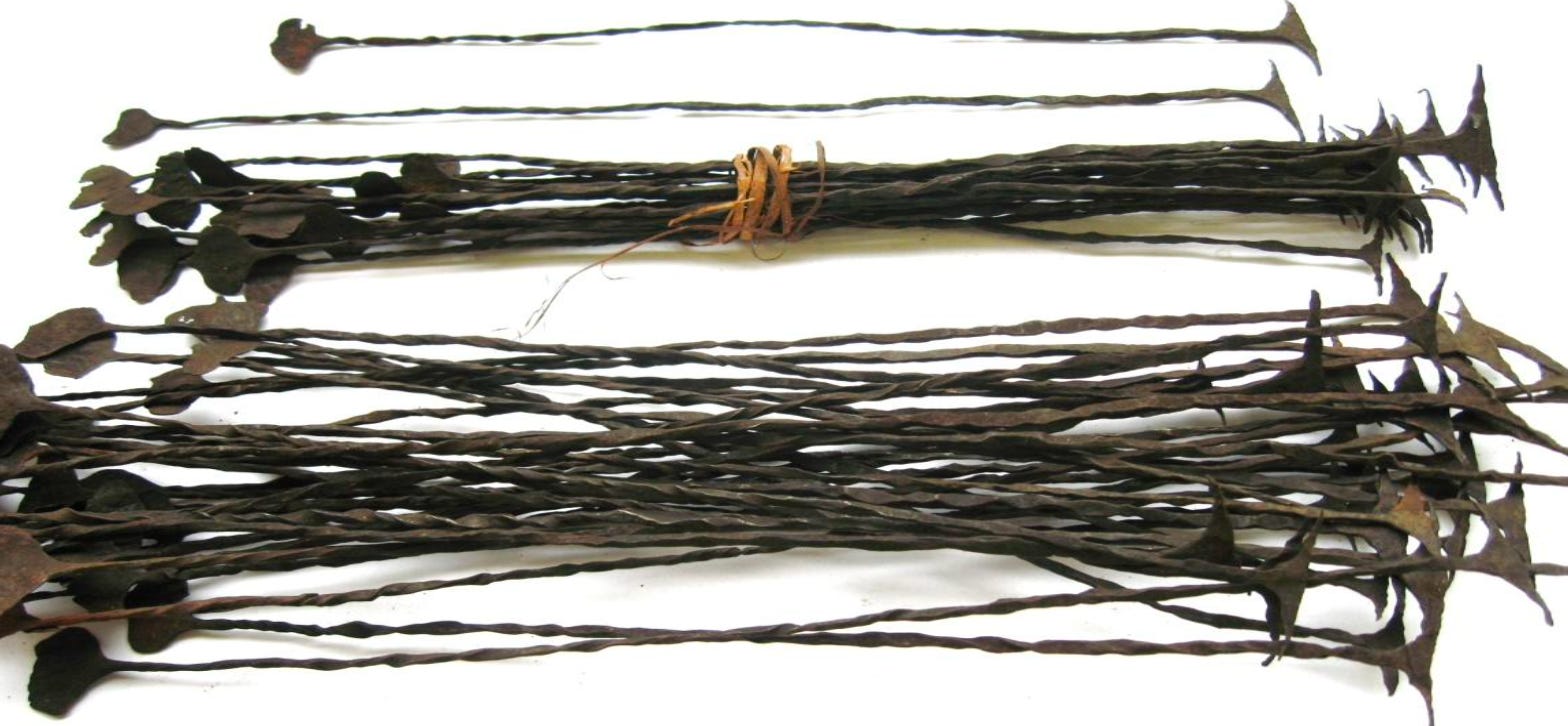
A Kissi Penny is a twisted iron rod, T-shaped at one end, hammered flat at the other. It is between 36 and 42 centimeters long, sinewy, rope-like. Hold a bundle of twenty, the standard trading unit and you are holding something that feels purposeful, like a tool that knows what it’s for.
In West Africa, among the Kissi people of Guinea, Liberia, and Sierra Leone, as well as their neighbors the Loma, Kpelle, and Banda, these rods circulated as currency from at least the early 20th century. The iron was smelted in two Mandingo villages, worked to a specific quality, because iron that can be twisted and hammered this precisely is high-grade iron, and everyone knew it.
The Soul Clause
Here is the detail that separates the Kissi Penny from every other currency in the collection: it has a soul.
If a Kissi Penny breaks, its soul escapes. The rod is worthless. It cannot be used to buy anything, not a cow, not a handful of rice. To restore its value, the broken piece must be brought to a medicine man for ritual reincarnation. Only then does it circulate again.
This is, arguably, the most honest theory of money ever articulated: currency has value because something invisible animates it, and the moment that something leaves, the object is just metal.
Central banks have never said this out loud, but the logic is identical. A euro note is paper. A dollar is cotton and linen. What makes them money is the soul, the collective agreement that they mean something. The Kissi Penny simply made this metaphysics explicit and gave it a name.
The Exchange Rates
A single Kissi Penny had very little purchasing power. Transactions happened in bundles. One cow: 100 bundles of 20. One woman (bride price): 60 to 80 bundles. In 1919, a French franc coin was worth 40 to 50 individual Kissi Pennies, colonial currency and indigenous currency existing in uneasy parallel, each with its own physics.
Still Here
The 60 pieces in the Alex Schütz Collection were made between 1900 and 1940. They are well-traveled objects, through markets, across borders, through hands that negotiated in a language that had no word for central bank or monetary policy but understood perfectly well that some money has a spirit and some doesn’t.
Next Tuesday: Chevron beads, how a trade secret guarded under pain of death in 15th-century Venice ended up buying slaves on the Guinea Coast, and why a single stolen bead once cost its thief twelve human lives.
ASC | Object. Power. Culture. publishes twice weekly. The Alex Schütz Collection documents 2,210 pre-monetary payment objects from five continents.