
The First Inflation Crisis in Recorded African History
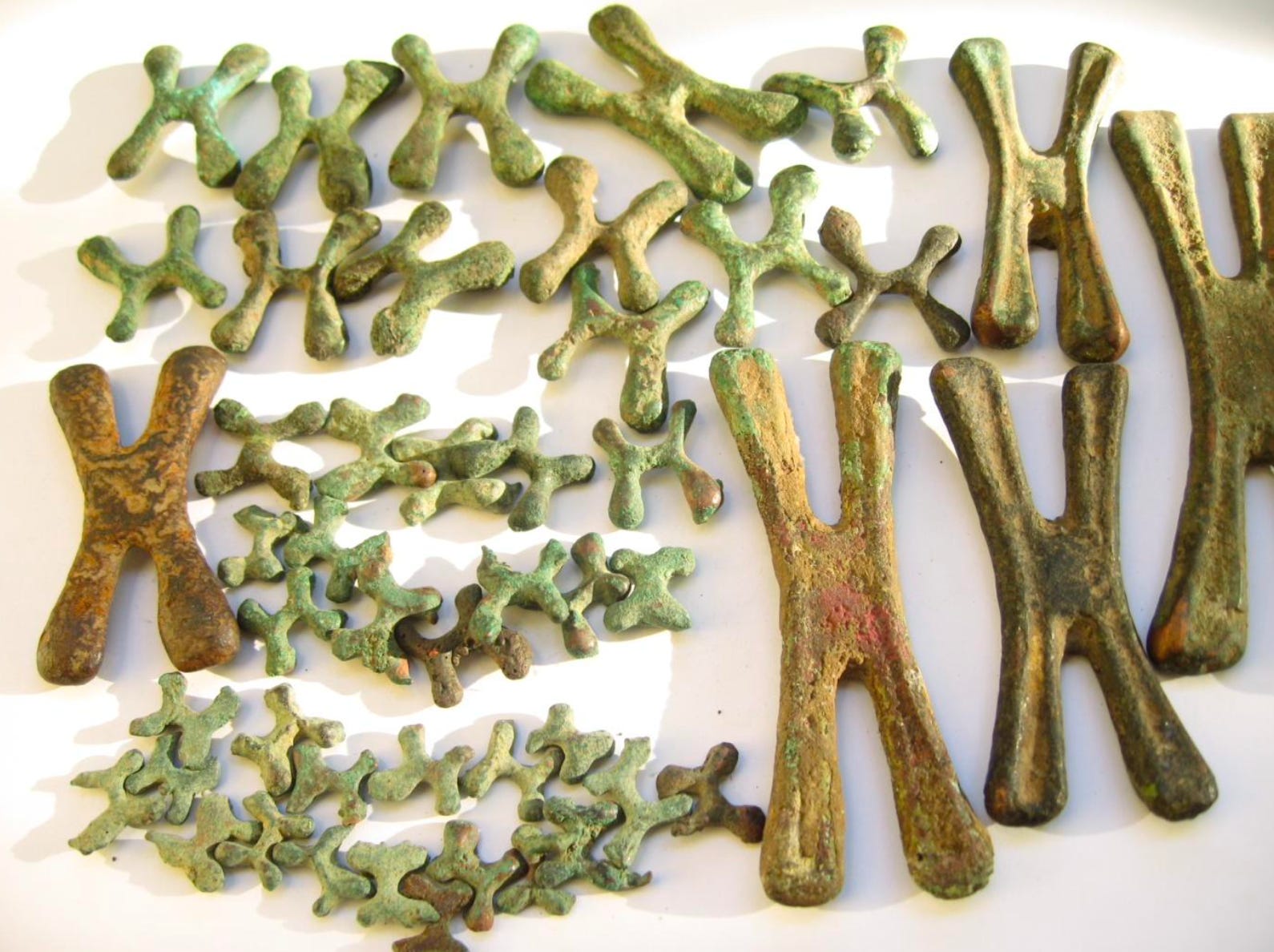
The Handa is the older sibling of the Katanga cross, smaller, simpler, predating the cross by centuries. The collection holds 53 of them, ranging from 1 to 10.2 centimeters, some barely thumb-sized. The earliest were found in graves at Upemba, at the headwaters of the Lualaba River, bundled in the hands of the dead.
For a long time, the Handa was the currency of the region, circulating across what is now the Democratic Republic of Congo, functioning as money for markets, brideprice, and burial. Then the Katanga cross arrived and the Handa became its small change. A copper economy with denominations.
What Happened Next
Toward the end of the 19th century, the Handa flooded. Too many were made, too quickly, circulating in too high a volume for the exchange system to absorb. The value collapsed. People stopped accepting them. The Handa was replaced by cowrie shells and glass beads, older, foreign forms of money that had held their value because no one could manufacture them locally in infinite quantities.
This is the oldest documented monetary inflation in central African history: a currency destroyed not by war or famine but by its own proliferation.
The mechanism is identical to every hyperinflation that followed, across every century, on every continent. When a currency can be produced without limit, and is produced without limit, the agreement that gave it value dissolves. The Handa’s problem was not that it was copper. It was that there was too much of it.
The Dead Knew Better
The earliest Handas were found in graves, bound together in human hands, buried with people as wealth to carry into whatever came next. No one buried their money because it was worthless. The grave Handas predate the inflation by centuries. They are evidence of a time when these small copper crosses meant enough to take with you.
In the collection, the smallest Handas fit between two fingers. They have the weight of a large coin. Hold several together and you feel the logic of them, countable, stackable, easy to transport in quantity. Easy, also, to make too many of.
The Lesson the 19th Century Didn’t Learn
The Handa inflation happened just as European colonial currencies were entering the region. The cowries and beads that replaced the Handa were themselves being systematically devalued by European imports, the same mechanism, one layer up. The Kongo basin in the late 19th century was a place where every form of money was simultaneously collapsing into something else. The Handa was just the first domino.
ASC | Object. Power. Culture. publishes weekly. The Alex Schütz Collection documents 2,210 pre-monetary payment objects from five continents.