
The Most Successful Currency Ever to Exist
Issue 04 · Friday | THE SHORT CONNECTION
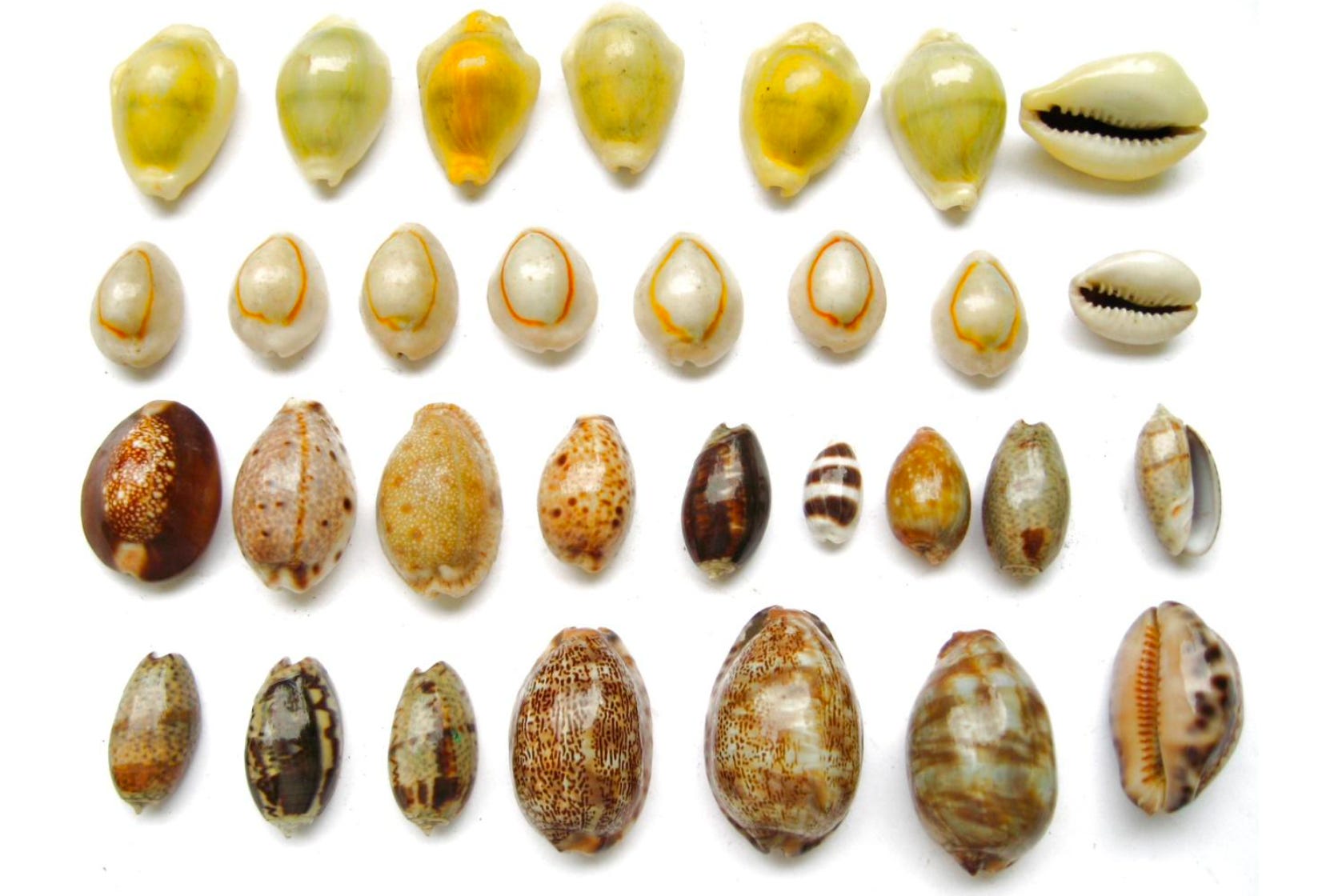
No currency in human history has circulated at more places on earth than the cowrie shell. Not gold. Not silver. Not the dollar. The small, glossy, cream-colored shell of the Cypraea moneta traveled from the Ryukyu Islands of Japan to China 1,500 years before the common era, spread across Persia, India, and nearly all of Africa from the Maldives outward around 400 CE, and was still being used as money in parts of West Africa in the 20th century.
The collection holds 28 specimens. They are light, smooth, and satisfying in the hand, the underside slit like a half-open eye. Easy to count, hard to counterfeit, durable across decades of use. The cowrie was not money by accident. It was money by design, in the way that a thing perfectly suited to a function eventually becomes synonymous with it.
The Price of a Wife (Across Five Centuries)
The catalog contains one of the most quietly devastating data series in monetary history. In Uganda:
Around 1600 — a wife cost 2 cowries.
In 1810 — a wife cost 30 cowries.
In 1857 — a wife cost 10,000 cowries.
This is bride-price inflation across 250 years, denominated in shells, tracking the moment when global trade flooded local markets with a currency that had once been scarce.
By 1866, a sack of 20,000 cowries was worth 4 dollars. By 1902, around 1 dollar. The Venetians had moved in, then the Portuguese, Dutch, and English, all shipping cowries from the Maldives where they could be gathered by the thousands per person per day, bringing them to Africa where they were still valuable, using them to buy slaves, and in the process destroying the monetary system they were exploiting.
The Weight of Money
A horse among the Fulani cost 500,000 to 1,200,000 cowries. That is approximately 2.5 metric tons of shells. Moving that much currency required 50 human carriers. The cowrie was convenient for small transactions and catastrophic for large ones, a feature that says something important about the social structure that used it, and the scale at which trade was originally imagined to operate.
What Survived
The cowrie shell appears on the Nigerian naira. It appears in the name of the Maldivian currency, the rufiyaa, derived from the Sanskrit rupya. It is woven into jewelry, ceremony, and dress across three continents. The object proved more durable than the economies it supported, outlasting empire, slavery, colonialism, and the imposition of European monetary systems. The shell endures as symbol long after it stopped being money. Which may be the truest thing about symbols: they outlive their function.
ASC | Object. Power. Culture. publishes twice weekly. The Alex Schütz Collection documents 2,210 pre-monetary payment objects from five continents.