
The Silver That Paid for the Opium
Issue 05 · Tuesday
New website - take a look!
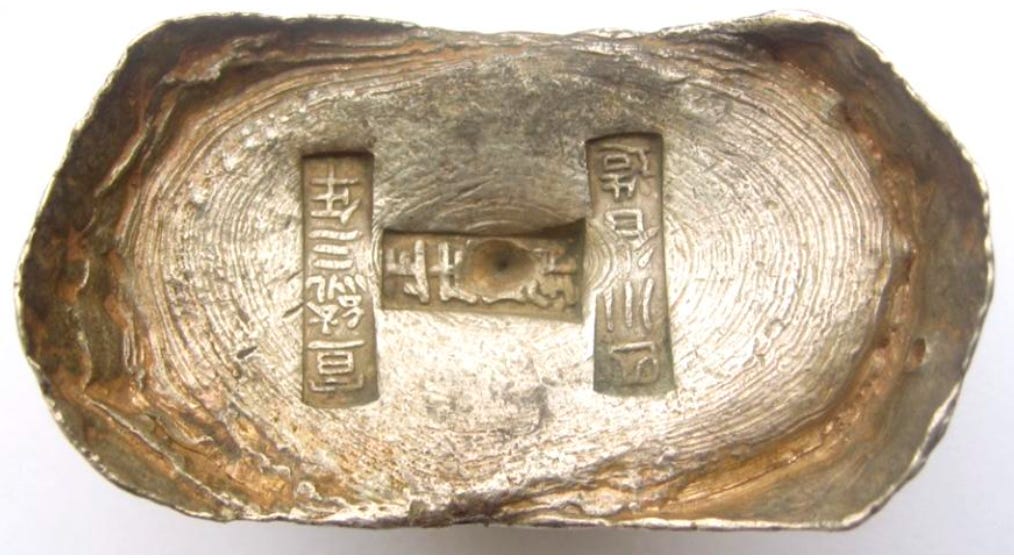
The Object
A sycee is a silver ingot, cast into a specific shape by a specific smith in a specific province, stamped with seals attesting to its purity and origin. The word comes from the Cantonese for “fine silk”, a reference to the surface texture of well-cast silver, which shimmers. The collection holds multiple triangle sycees: three-sided ingots, heavier than they look, each bearing two or three stamped characters.
One reads: “Geprägt in der Provinz Yunnan. Genügend reines Silber.” Cast in Yunnan Province. Sufficiently pure silver. Another: “Schatz”, treasure. Another carries the name of the emperor under whose reign it was struck: Hsien-Feng, first year, 1851. These are not coins in the modern sense. They are portable, verifiable chunks of trust.
Where They Traveled
The triangle sycee didn’t stay in China. It circulated in the Golden Triangle, the border region where Burma, Laos, and Thailand converge, and where, throughout the 19th and early 20th centuries, the world’s most productive opium fields were located.
The sycee was the settlement currency of the opium economy. When the trade was too large for barter and too dangerous for paper promises, silver ingots crossed the mountain passes.
The collection’s catalog notes, with characteristic precision, that many triangle sycees circulated in the opium-producing regions until 1970 and that many bore forged stamps. The counterfeit sycee is itself a historical artifact: proof that the currency was trusted enough to be worth faking, and that the trust was fragile enough to exploit.
The Infrastructure of Vice
There is a particular quality to objects that were used to settle transactions that could not be spoken about directly. The sycee has this quality. It is matter-of-fact. It has a weight and a purity rating and a provincial origin. It does not comment on what it purchased. Silver has always been like this neutral, reliable, indifferent to the moral valence of the exchange it mediates.
The Yunnan sycees in this collection carry the stamps of silversmith Ma and silversmith Zheng. These were real people with workshops and reputations. Their names on a sycee were a guarantee not unlike a brand hallmark today. The fact that their silver ended up paying for opium is not something their stamps record. The stamps only say: this is real, this is pure, this is mine.
From Shanghai Customs to Mountain Passes
In Shanghai, customs duties were paid in sycee. One tael, the standard weight unit, approximately 34 to 37 grams depending on region, was equivalent to 1.5 Mexican dollars, or 0.7 US dollars. Large debts settled in 50-tael bars. The same system, the same weights, the same provincial stamps, flowed south and west into the Triangle, where the exchange rate measured not import duties but poppy harvests.
The collection spans Chinese monetary history from the Tao-Kuang era (1821) to the early Republic (1933). Over those 112 years, China moved from imperial silver currency to something approaching a modern monetary system and the sycee became obsolete. The Triangle held on longer. It always does.
What These Objects Ask
Monetary history tends to present currency as a neutral infrastructure, the plumbing of commerce. The triangle sycee pushes back against this. It asks: neutral to whom? Infrastructure for what? Silver is indifferent. The hands that passed it were not.
ASC | Object. Power. Culture. publishes twice weekly. The Alex Schütz Collection documents 2,210 pre-monetary payment objects from five continents.