
The Trade Secret That Conquered Africa
Issue 03 · Tuesday | OBJECT OF THE WEEK
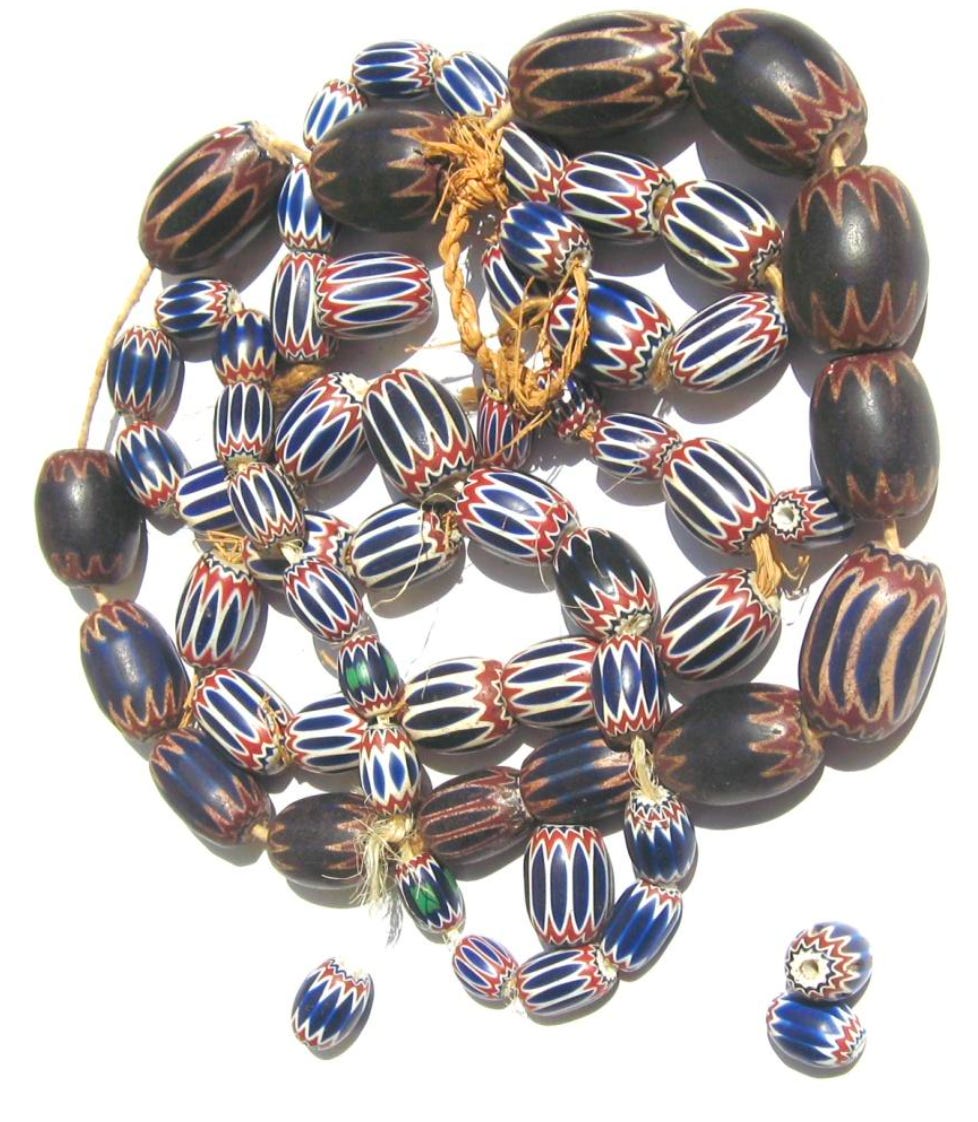
A Death-Protected Secret
In the glassblowing workshops of Murano, just off the coast of Venice, around the year 1500, craftsmen developed a new technique. They fused multiple layers of glass, typically five to eight, in blue, white, and red, around a central tube, then drew the mass into a long cane and cut it into beads. The result was a twelve-pointed star in cross-section, each layer distinct, the whole thing glittering with a depth that plain glass couldn’t achieve.
The Venetian guilds understood immediately what they had. The production secret was protected under penalty of death. When some glassblowers eventually fled to Holland and began making their own version, the Venetian monopoly cracked, but only partially. For over a century, chevron beads from Murano were among the most controlled manufactured goods in Europe.
From Murano to the Gold Coast
The beads traveled the trade routes south. By the mid-19th century, among the Ashanti in Ghana, a single chevron bead was worth up to four times its weight in gold. This is not a metaphor, it was the actual exchange rate. Glass, made in Italy, valued above gold in West Africa.
Among the Ashanti, a thief who stole a single chevron bead owed the owner twelve slaves in restitution. The bead was worth twelve human lives.
This price makes more sense when you understand the context. Chevron beads were not merely pretty objects. They were status technology, wearable proof of wealth, portable contracts of prestige. In markets where gold was locally produced and therefore relatively common, a bead that arrived from across the ocean, visually spectacular and difficult to replicate, commanded a premium that defied metallurgical logic.
The Structure of Beauty
The 64 pieces in the Alex Schütz Collection range from 1.7 to 4.7 centimeters. The smallest weigh 6 grams; the largest, 80. Hold one up to the light and the layers separate into distinct rings of color, the geometry of the thing is still intact after five centuries.
Today chevron beads are still worn in Togo and Benin at Voodoo ceremonies. They’ve outlasted the trade empires that spread them, the slave economy that priced them, and the colonial currencies that eventually replaced them. They are old enough to have forgotten being money and yet they still carry the weight of what they once were.
The Paradox
There is something unsettling and clarifying about chevron beads as currency: they are a perfect illustration of how arbitrary monetary value truly is. Gold has industrial uses. Cowrie shells are durable and counterfeit-resistant. But a glass bead from Murano is valuable in West Africa purely because enough people agreed it was and because the people who first introduced it were also selling slaves, and the bead became entangled with that economy until it was inseparable from it.
The bead didn’t become money by accident. It became money because someone decided it would be useful for extracting other things of value from people who had different things of value. The death-protected secret from Murano was, in the end, a colonial instrument wearing beautiful clothes.
ASC | Object. Power. Culture. publishes twice weekly. The Alex Schütz Collection documents 2,210 pre-monetary payment objects from five continents.