
Three Iron Leaves for 36 Men and Some Animals
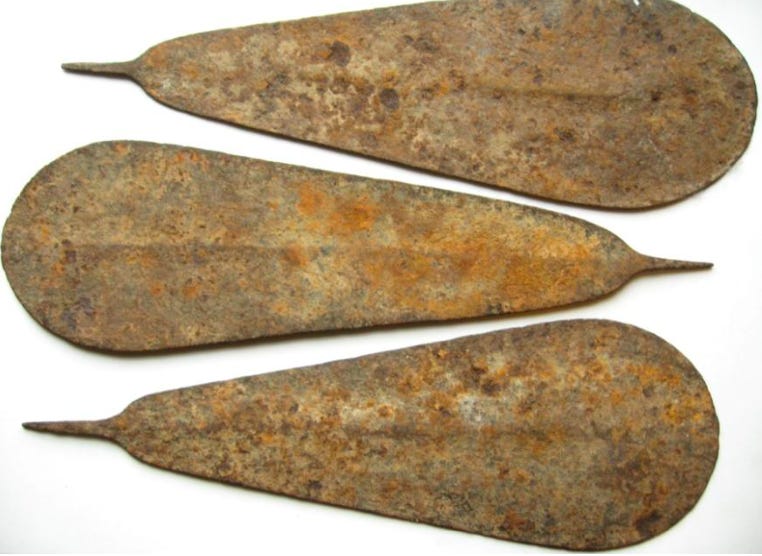
David Livingstone was crossing Lake Bemba with 36 expedition members and several animals. He needed a ferry. The price: three Dupa iron leaves.
Livingstone recorded this transaction in his journals. It is one of the few moments in the catalog where a named historical figure appears as a participant in an exchange, not an observer, not a commentator, but someone who reached into a bag and paid. Three flat iron objects, shaped like leaves, approximately 38 by 11.5 centimeters each, for the crossing of a lake with three dozen people and their animals. The Dupa was not small change.
The Object
The Dupa is a large, flat iron blade, leaf-shaped, wide, hammered thin. The collection holds three, each weighing 363 grams. They come from the territory around Moloundou in northeastern Congo, produced by the Bakwele and Makaa peoples. They circulated as rare currency until 1985, which is to say, within living memory.
They were used for brideprice, for trade, and from 1894 onward, as a form of colonial tax: two Dupas per household, or three rupees, the administration offering a choice between the local currency and the imperial one, treating them as equivalent.
The moment a colonial government accepts your iron money as tax payment is the moment it begins to control the supply of that money, and therefore the moment it begins to replace it.
The Longevity of Iron
Iron money is among the oldest forms of currency in sub-Saharan Africa. Unlike copper, which could be cast into standardized shapes, iron required skilled smithing, each piece was worked, not poured. The labor itself was part of the value. A Dupa was not just iron; it was iron plus skill plus time.
This is one of the more interesting theories of pre-monetary value: that a currency embeds not just material worth but the cost of its production. Modern money has tried to forget this. The Dupa makes it impossible to forget. You can feel the hammer in it.
Still Moving
The catalog notes that today the Labwar people use similar objects for trade with neighboring groups. The Dupa, or something like it, has not entirely disappeared. Livingstone’s ferry crossing happened in the 19th century. The currency he paid with was still circulating in the 1980s. Some forms of money outlive the empires that tried to replace them.
ASC | Object. Power. Culture. publishes weekly. The Alex Schütz Collection documents 2,210 pre-monetary payment objects from five continents.