
What if protection was already capital?
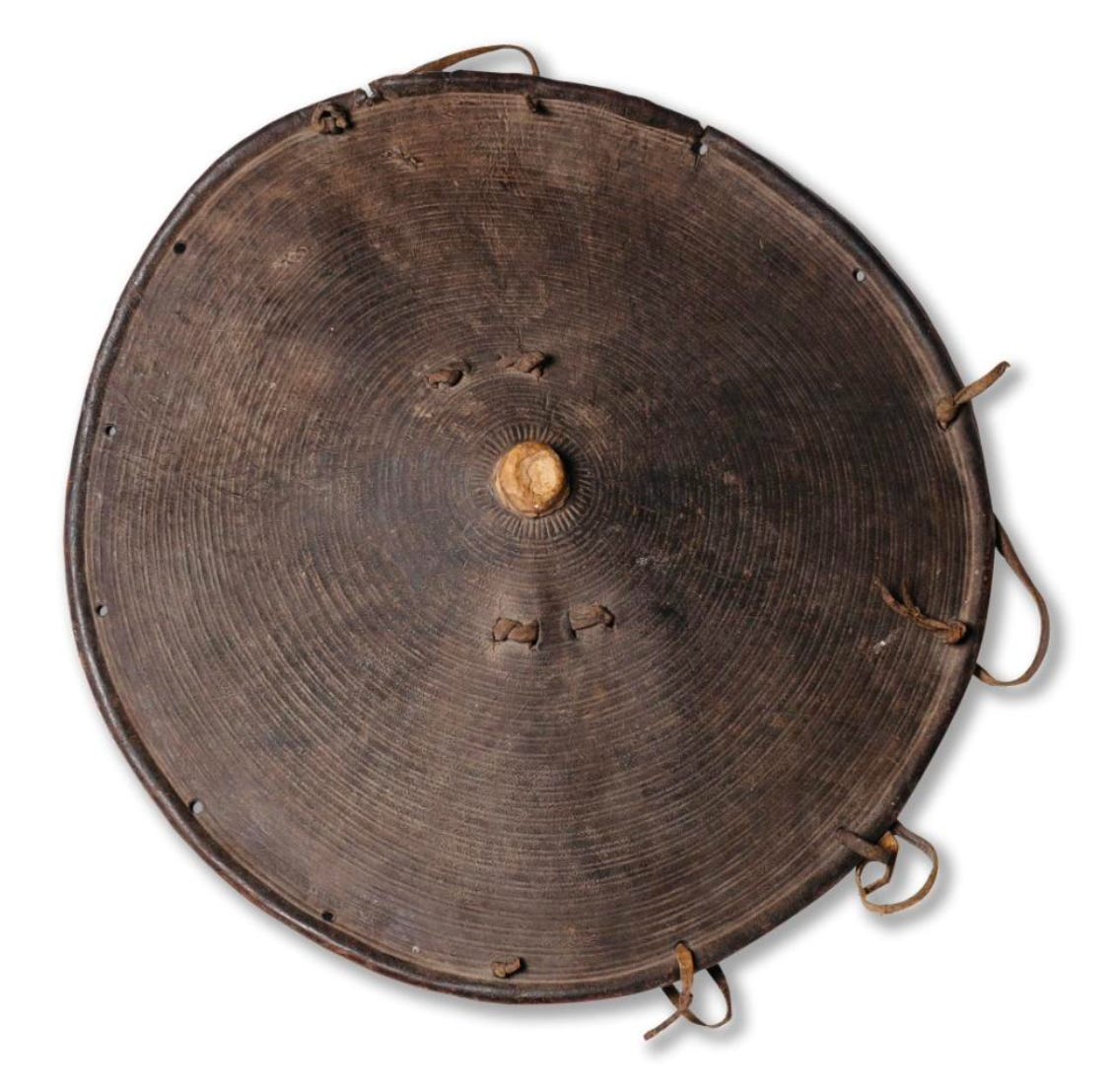
Not insurance.
Not abstraction.
But something you could hold in front of your body.
What happens when survival itself becomes a store of value?
Shield (Kafa, Ethiopia)
Early 20th century
∅ ~58 cm • 2,010 g
Made from thick hide, often rhinoceros or similar durable material, shaped into a circular defensive form.
At first glance: a weapon accessory.
In context: something more.
Material as Value
In 1862, the British explorer Samuel White Baker noted:
One rhinoceros hide could produce seven shields
Raw hide already had a measurable market value
The horn was traded separately, used for sword hilts
This reveals a layered economy:
animal → raw material
raw material → manufactured object
manufactured object → value-bearing asset
The shield is not just protection.
It is processed wealth.
From Resource to Object
The transformation matters.
A hide in itself has value.
But once shaped into a shield, it gains:
durability
functionality
recognizability
exchange potential
Labor converts material into stabilized value.
The object becomes both:
tool (defense)
store of value (tradable asset)
Protection as Investment
A shield operates in two dimensions:
Immediate function → protection in conflict
Deferred function → value in exchange
This duality is crucial.
Unlike modern financial assets, which separate utility and value,
this object combines them.
You invest in something that:
can save your life
and can be traded
Embedded Economy
The pricing Baker describes, hides, horns, finished objects, points to a material-based valuation system.
No abstraction.
No currency layer required.
Value is:
measurable
divisible (hide → multiple shields)
convertible (horn → different product)
An integrated economic chain.
Why This Matters
Modern systems separate:
consumption
investment
protection
Here, they are unified.
The shield is:
insurance
asset
commodity
All in one object.
A Question for Now
If value once came from objects that directly affected survival,
what happens when value becomes detached from function entirely?
If you’re interested in systems where material, function, and value are inseparable, follow.
Because before finance abstracted risk,
people carried it with them.